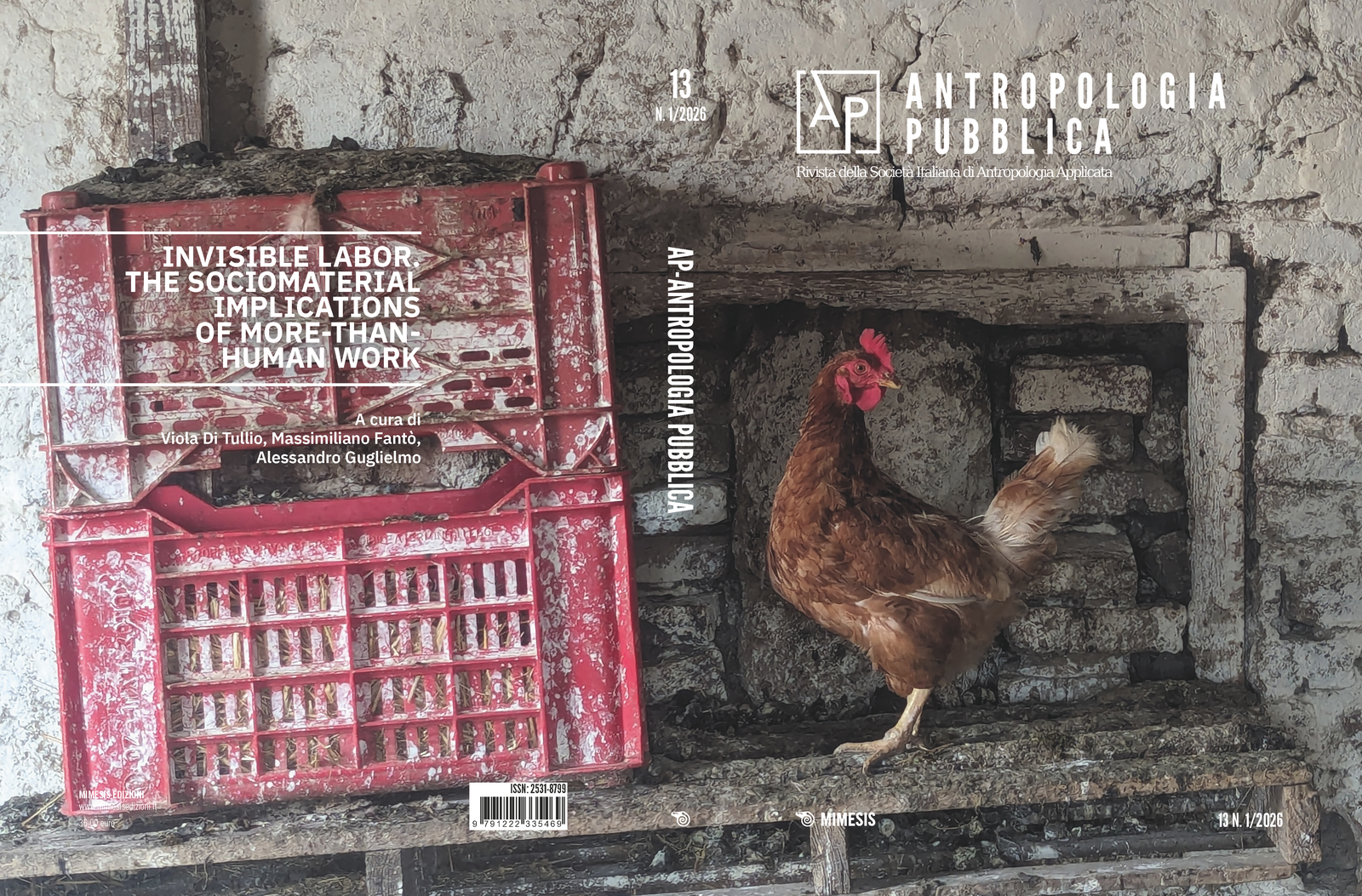
Labour in Flesh and Feathers. Multispecies Mutuality Against Agroindustrial Invisibility
DOI:
https://doi.org/10.7413/2531-8799067Keywords:
Multispecies ethnography; More-than-human labour; Degrowth; Australia; Poultry breeds.Abstract
This article explores “more-than-human labour” through multispecies ethnography among small-scale breeders of heritage and rare poultry in Australia. Animals are not passive recipients of care but active participants in agricultural processes, performing metabolic, reproductive, ecological, and affective work that sustains life. Based on one year of participant observation, conducted in Western Australia, Queensland, and New South Wales, the study shows how farmers recognise in their birds will, sensitivity, and agency. Chickens, ducks, and turkeys interact, resist, and shape human gestures, giving rise to hybrid and affective ecologies where care and control intertwine. Rereading rural husbandry through this lens questions the human monopoly over work and value, revealing relational and peripheral economies where humans and nonhumans co-produce life and meaning. Yet these relations remain ambivalent, traversed by asymmetries of domestication and dependency. Tracing six interwoven dimensions of more-than-human labour – metabolic, reproductive, affective, ecological, aesthetic, and political – the paper shows how slow, caring practices in small farms become forms of ethical resistance and regeneration. Valuing these fragile collectives invites us to imagine agricultural policies attentive to interdependence, post-anthropocentric educational paths, and multispecies economies that transform the ruins of capitalism into grounds for shared survival.